HTTP Event Collector (HEC)
The HTTP Event Collector (HEC) output is a high-performance, token-based API used to stream processed network telemetry directly to modern analytics platforms. It is the preferred method for delivering data to Splunk and CrowdStrike Falcon LogScale because it supports high-volume ingestion over HTTPS without the overhead of traditional Syslog.
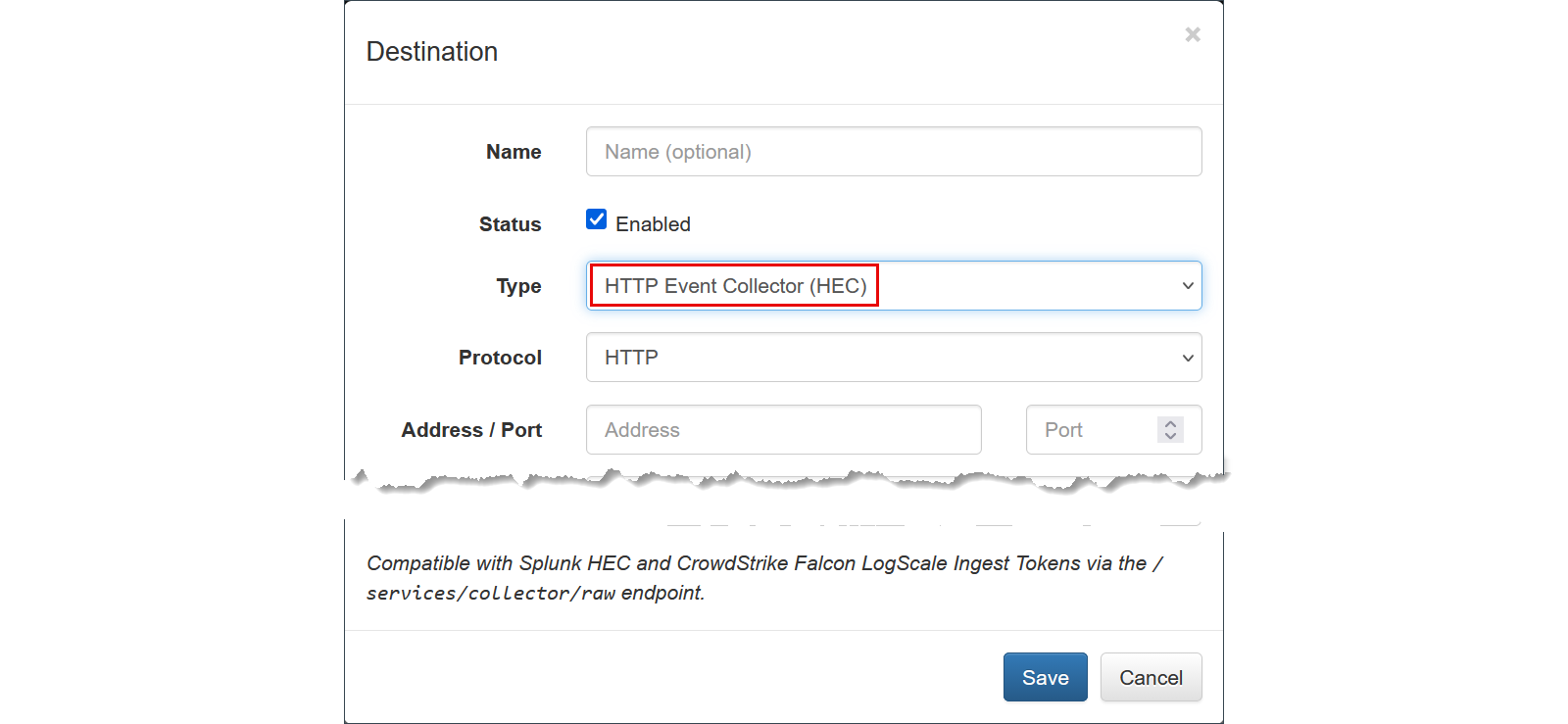
Configuration Parameters
| Parameter | Description |
|---|---|
| Protocol | Select HTTP or HTTPS. HTTPS is recommended for production environments to ensure data encryption in transit. |
| Address | The destination IP address or Hostname of the analytics platform (e.g., splunk-server.example.com or cloud.community.humio.com). |
| Port | The destination port number (Default for Splunk is typically 8088; for LogScale, it is often 443 for cloud or 8080 for on-prem). |
| Format | Select JSON or Syslog. JSON is highly recommended for structured analytics in both Splunk and LogScale. |
| Access Token | The unique authentication token provided by your platform. • Splunk: Use your HEC Access Token. • LogScale: Use your Repository Ingest Token. |
| CAcert file name | The CA certificate file name (PEM format) required for HTTPS verification. |
| Max batch size | The maximum buffer size in bytes. When reached, NFO pushes the data to the destination. |
| Flush timeout | The interval in milliseconds after which NFO data is sent, even if the maximum batch size has not been reached. |
Platform Specifics
Splunk
For Splunk environments, ensure that HEC is enabled in your Global Settings and that your token is associated with the correct Source Type (e.g., flowintegrator) and Index (e.g., flowintegrator).
- Standard Endpoint:
/services/collector/event
Splunk Machine Data Lake
Machine Data Lake (MDL) ingests over HEC, so NFO sends to it with the same Splunk HEC output described above. No additional NFO configuration is required, and no separate endpoint or token type is involved.
Routing to MDL is configured on the Splunk side. You create a raw table and define landing conditions that match on source, sourcetype, or host. Events matching those conditions land in the raw table in object storage rather than being indexed, and you later promote the subset you need into an index or an analytics table.
The practical consequence for NFO is that the Source Type carried by your HEC token is what MDL matches on. Using a dedicated sourcetype such as flowintegrator lets you land NFO data in its own raw table without affecting other sources.
Landing a sourcetype in MDL changes where those events go. Validate the landing configuration with a test event, and confirm that any index route you intend to keep still receives its copy, before relying on it in production.
CrowdStrike Falcon LogScale
LogScale provides a Splunk-compatible HEC endpoint. The Ingest Token you provide determines which Repository and Parser will be applied to the data.
- Standard Endpoint:
/api/v1/ingest/hec - Authentication: LogScale HEC endpoints are designed for compatibility and accept the standard
Authorization: Splunk <Token>header format used by NFO.
When using the HEC output for CrowdStrike Falcon LogScale, ensure that an appropriate NFO parser is assigned to the Ingest Token within the LogScale UI to correctly structure the incoming JSON fields.
Troubleshooting
- Verify Connectivity: Ensure that the NFO server has network access to the destination Address and Port.
- Token Validation: Double-check that the Access Token is active and has permissions to write to the intended index or repository.
- SSL/TLS Errors: If using HTTPS, verify that the
CAcertmatches the certificate chain of the destination server.